



The Relationship between Gold, Stock and Oil Prices
The relationship between gold, stock, and oil prices is an important component of the global financial system. Gold is commonly regarded as a safe-haven asset, stocks represent corporate performance and economic growth, while oil is a vital commodity that influences production costs and inflation. Therefore, increases in oil prices generally raise production costs and reduce corporate profitability. Higher operating costs may lower firms’ earnings and consequently depress stock prices. In oil-importing countries, rising oil prices often contribute to inflationary pressures and slower economic growth, which negatively affects stock market performance. Conversely, declining oil prices reduce production expenses, increase consumers’ purchasing power, and stimulate economic activity, thereby supporting stock market growth. The relationship between oil prices and stock prices is not always negative. During periods of strong economic expansion, increasing oil prices may reflect rising global demand rather than supply disruptions. In such circumstances, higher oil prices may coexist with rising stock prices because both are driven by robust economic growth. Therefore, the sign and magnitude of the relationship depend on whether oil price changes are demand-driven or supply-driven.
Gold prices, on the other hand, exhibit a distinct relationship with stock prices. Gold has traditionally been viewed as a safe-haven asset that preserves wealth during periods of economic uncertainty and financial turmoil. When stock markets experience significant declines, investors often shift their portfolios toward gold to reduce risk exposure. This phenomenon creates an inverse relationship between gold and stock prices. Further, oil prices also influence gold prices through several channels. One important mechanism is inflation. Rising oil prices increase transportation and production costs, potentially leading to higher inflation. Since gold is widely considered a hedge against inflation, investors tend to increase their demand for gold when oil prices rise, driving gold prices higher. Therefore, a positive relationship often exists between oil and gold prices. Another important factor linking oil and gold prices is the value of the U.S. dollar. Because both commodities are primarily priced in U.S. dollars, fluctuations in the dollar can simultaneously affect their prices. A depreciation of the dollar generally makes gold and oil cheaper for holders of other currencies, increasing demand and pushing their prices upward. Conversely, an appreciation of the dollar tends to exert downward pressure on both commodities. Consequently, movements in exchange rates frequently contribute to the positive correlation observed between gold and oil prices. The interrelationship between gold, oil, and stock prices is also influenced by investor sentiment and global economic uncertainty. During periods of geopolitical conflicts, pandemics, or financial crises, oil prices may fluctuate significantly due to disruptions in supply and demand. Such uncertainty often causes stock markets to decline, encouraging investors to seek refuge in gold, thereby strengthening the negative relationship between gold and stocks and the positive relationship between oil and gold.
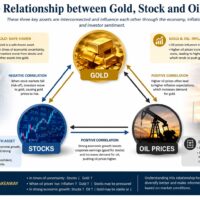 Picture Source: created by Chatgpt, 2026

Comments :